Ayrton Senna: 3 World Titles, 41 Wins and an 8x Growth Brand
The family money, the hard bargaining and the engineering obsession behind the racing, and the licensing business and charity his name built.
Listen to this article 11 min, narrated
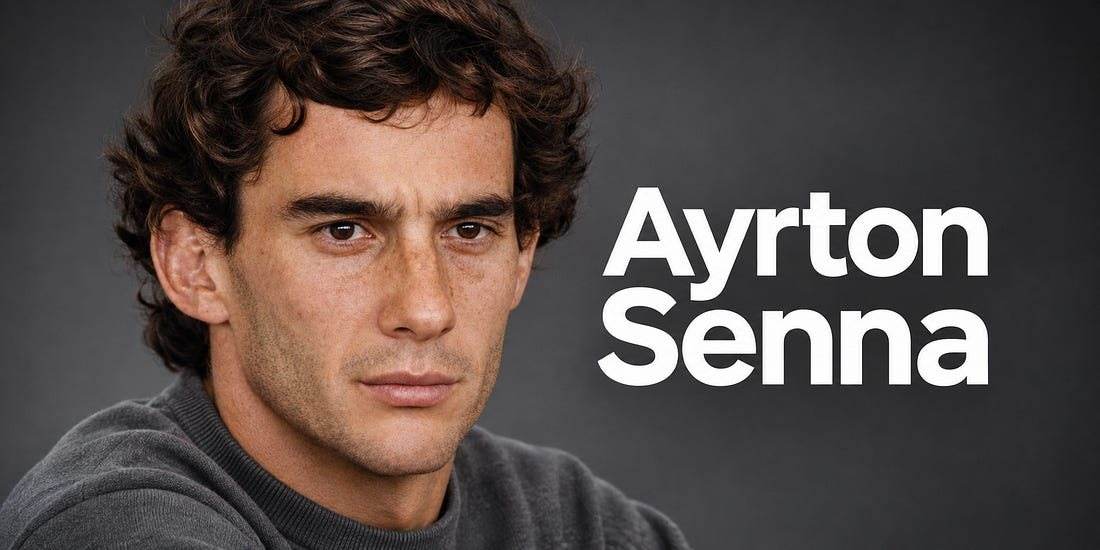
Two men could not agree on half a million dollars a year, so they flipped a coin. Only afterward did they realize the contract ran three years, which turned the argument into a $1.5M toss. Ron Dennis, McLaren’s team principal at the time, says he won it. The man on the other side was Ayrton Senna, whose appetite for money Dennis called pretty healthy. Of course it was. Senna wanted the fastest car, a fix for every problem he found and the home win nobody could take from him. He won three world championships and 41 Grands Prix, then died at 34 years, 1 month. His name kept earning. Senna Brands, the family company that licenses it, said in a release dated April 29, 2026 that its revenue grew eightfold over the prior six years. The Instituto Ayrton Senna, the charity his sister Viviane founded in November 1994, drew between 31% and 62% of its operating revenue from royalties on his brand and image across its 2022 to 2025 annual reports.
Senna was born in São Paulo on March 21, 1960, into a wealthy family and never needed to race for money. His father, Milton da Silva, owned land and a factory, and gave the boy a miniature kart at 4 y.o. At 13 y.o., Senna raced a kart for the first time and won on the spot. It sounds like a fairy tale. It came with a string. The family expected a businessman, and he faced pressure to give up racing for the family firm.
View on Instagram
In 1981 Senna took a seat with Van Diemen in British Formula Ford 1600 and paid £10K for the place, funded by his father, like almost every driver on the grid. The money bought a burst of brilliance: 12 wins in 20 races and both major British titles. Then the sponsors stayed away. Frustrated, he quit and went home to help his father in the business, as agreed. A champion with that record sat behind a family desk. Along the way he divorced his young wife and gave up a future in his father’s businesses.
View on Instagram
He still needed money to move up. In 1982 he lacked the budget to step straight into Formula 3, so he raced Formula Ford 2000 and won 22 times. In 1983 he took the British Formula 3 title from Martin Brundle after a run of nine straight wins. Along the way he said no. Dennis offered to pay for his Formula 3 season in exchange for an option on his services, and Senna declined. He turned down Williams too. Dennis admitted he did not exactly like the independence, and respected it anyway.
Toleman gave him a Formula 1 debut in 1984 and a rain-soaked second place at Monaco. Lotus added six wins and 16 poles in three seasons. Formula 1’s 2020 analysis of every qualifying session since 1983 compared teammates to strip out the car and ranked Senna the fastest driver over one lap, 0.114 seconds ahead of Schumacher and 0.275 ahead of Hamilton. Then Senna decided the fastest road ran through McLaren. He put out feelers, saw a competitive team and suggested he might convince Honda to come along, Dennis recalled. The driver recruited the engine to win the seat. Dennis called him politically astute and saw an ally.
Honda’s engineers found him exhausting and invaluable. Data engineer Toyoharu Tanabe remembers Senna announcing that the throttle pedal was not fully open. It was about 2 mm short. After every engine failure Senna demanded to know what went wrong and what Honda planned to do about it, and the questions ran until the next race. In 1988 McLaren- Honda won 15 of 16 races, and Senna beat teammate Alain Prost eight wins to seven for his first title.
The same intensity produced his ugliest moment. At Suzuka in 1990 Senna took out Prost’s Ferrari at the first corner and won the title. Dennis checked the telemetry traces, told Senna he was disappointed and called it one of the driver’s rare moments of weakness. Senna’s own explanation, as Dennis recalled it: if he could not reach the corner first, he would not be exiting it. By 1993 McLaren paid him $1M per race. A man who flipped a coin over half a million knew exactly what he was worth.
View on Instagram
Senna failed to win his home race seven times. On March 24, 1991, he finally led it from pole, and then the car began to die. With about 20 laps left, fourth gear went. Nigel Mansell retired on lap 60 with a transmission failure, and Riccardo Patrese sat 40 seconds back. The win looked safe. It was not. With seven laps to go, fifth and third gears vanished too, and Senna left the car in sixth. The Honda V12 nearly stalled in the slow corners and gave no engine braking in the fast ones. He lapped near 1:28 while Patrese ran 1:21s. The gap melted to 2.99 seconds at the flag. Senna stalled just after taking it, sat spent in the cockpit and fought cramps to lift the trophy. His verdict: God gave me this race. Anyone who watched him nurse that car home saw skill, nerve and a man protecting what he had left.
Senna died at Imola on May 1, 1994, at 34 years, 1 month. Roland Ratzenberger died in qualifying the day before, on April 30, 1994. Senna’s Williams left the road at Tamburello after five laps. The weekend ended 12 years without a Grand Prix fatality. Brazil observed three days of national mourning and some half a million people lined the streets for his funeral.
The sport changed: circuit and barrier changes in 1994, higher cockpit sides in 1996, wheel tethers in 1999 and mandatory head-and-neck restraints in 2003. Those were separate fixes for separate hazards, built by many people over nearly a decade.
In 2024 the Instituto booked $4.8M in royalties out of $7.7M in operating revenue, about 62%. Of that royalty income, $3.3M came from the Instituto’s own logo and $1.5M from Senna’s image. A licensing company, L&V Licensing, exploits the rights and passes the Instituto a share of net profit each year. A year earlier royalties made up only 31% of revenue, because corporate donations reached $6.0M. The accounts are in Brazilian reais, and every dollar figure here is converted at 5.43 reais per dollar, the Federal Reserve’s rate on October 30, 2026.
Here is the twist. The Instituto held about $49M in securities and earned $4.4M in financial income in 2024. That income turned an operating deficit of $1.0M into a surplus of $3.3M. Royalties fund much of the program, but the endowment keeps it standing.
The commercial arm, Senna Brands, is led by CEO Bianca Senna, and Ducati built a 341-unit Monster Senna with it in 2024. The same release counted more than 65 licensing partners and gave no revenue figure, so eightfold is a ratio without a base. TAG Heuer began its official partnership with Senna in 1988. When you buy something with a hero’s name on it, do you want to know where the money goes?
View on Instagram · @sennabrasil
- Price the freedom inside an offer. Senna turned down money from McLaren and Williams, and Dennis respected the independence even while disliking it.
- Turn complaints into data. Honda could measure a 2 mm throttle shortfall because Senna described it precisely.
- Recruit the resources you need. Senna offered to bring Honda along, and the engine opened the door to the seat.
- Limit your own ambition. Suzuka in 1990 shows what the same drive does without a limit, and Dennis told Senna he was disappointed.
- Protect what still works. At Interlagos in 1991 Senna kept the car in sixth gear and held a lead that was shrinking by the lap.
- Assign ownership after a failure. Tethers, cockpit sides and head- and-neck restraints came from specific work over years, not from one reaction.
- Read the full financial statements. Royalties covered 62% of the Instituto’s operating revenue in 2024, which sounds like dependence on a famous name. The audited accounts also show $49M in investments that earned $4.4M that year, more than enough to cover the operating deficit. One number can mislead, and the full statements show whether a charity or a brand can stand on its own.