Rafael Câmara: His Grandmother Raced Interlagos in 1965. Haas Gave Him the Same Track for His F1 Debut
The lawyer father, the racing grandmother, the move to São Paulo, the Ferrari academy, two titles by 20 and the Haas test that made him the first driver from the Northeast to race in F1 for Brazil.
Listen to this article 22 min, narrated
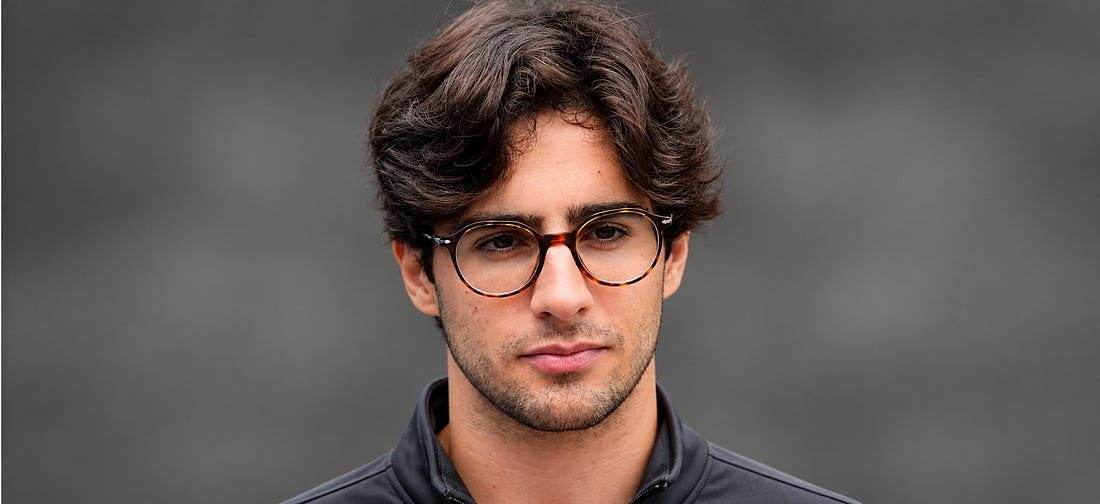
On June 16, 1965, Niege Rossiter, a psychology student from Recife, drove a DKW Vemag numbered 6 to fifth place in a women’s touring-car race at Interlagos. Sixty-one years later, her grandson Rafael Câmara was scheduled to make his Formula 1 debut on the same circuit. He was supposed to drive a Ferrari in Friday practice at the São Paulo Grand Prix and watch the race from the garage. Instead, Haas confirmed on November 3, 2026 that Esteban Ocon would not race for the team again that season, and that Câmara, a 21-year-old already signed for 2027, would partner Ollie Bearman at Interlagos, a year earlier than planned.He was leading the Formula 2 championship by 7 points at the time, two months after a two-day test in a year-old Haas in which he beat the team’s own reserve drivers. This profile covers the family that moved twice for his racing, the grandmother who raced before he was born, the 2021 Ferrari selection, two titles in two rookie seasons, the sponsors who followed him up the ladder, and the test that earned him the seat.
View on Instagram
THE FAMILY BEHIND THE NAME
Rafael Chaves Câmara was born on May 5, 2005 in Boa Viagem, the beachfront district on the south side of Recife, the capital of Pernambuco in Brazil’s Northeast. His father, Amaro Câmara, is a lawyer. His mother, Paula Chaves, is described in the Brazilian press as a businesswoman. In the Brazilian naming convention, Chaves is his mother’s family name and Câmara his father’s, which is why he races as Câmara and why he has no relation to Sérgio Sette Câmara, the Brazilian who won Formula 2 races in 2018 and 2019.
The racing in the family came through his mother’s side, and it started two generations back. His great-grandfather, Nelson Rossiter, ran a bus company, Viação Bonfim, on the Recife to Maceió route, and was one of the first people to race cars in Pernambuco in the early 1960s. His daughter, Niege Rossiter, entered a jeep marathon at the Caxangá Golf Club in Recife on May 6, 1962, the only woman among 16 entrants, and won it, with her father third behind her. From then on they shared a car in the 500 Kilometers of Recife, run on a 3 km circuit at the university campus. In July 1964, in Rio de Janeiro, she won the “20 Laps for Women” at Barra da Tijuca from start to finish in a Willys Interlagos her father had given her days before, and cried in his arms afterward. She was 19 and studying psychology. Asked by the magazine Quatro Rodas whether she planned to race at Interlagos, she said yes, “unless a handsome young man comes along.” She went in June 1965. She finished her degree, married Paulo Fernando Morato Chaves, and had three children; the youngest, Paula, is Rafael’s mother.
View on Instagram
Her grandson grew up in a house with her trophies on display and did not know the stories until he started racing himself. “My grandmother was the first woman racer in Recife and also a pioneer in the family. My uncle also did karting, and I, after so many years, started this career.” In 2023, in his first Formula Regional seasons, he ran the number 8 in her honor. She watched him race in karts and later in Formula 4 at Monza in Italy.
View on Instagram
A KART AT 6, A MOVE AT 8
The first kart arrived through his older brother. “My dad at work, he had a friend, whose son was starting in karting… My brother is five years older than me, so my dad took him to the go kart track to do some laps, and he was doing it for half a year, but he didn’t really like it.” The track, the Kartódromo do Tamboril, was 40 minutes from home, and Rafael, at 5, got up every Saturday and Sunday to go along. Drivers could not start before 6, so he asked his father for his turn the day he was old enough. He started in 2011. His father’s version: the older son, João Filipe, went to water polo, and the younger one stayed with the car.
Recife has a small karting scene. In January 2014, when Rafael was 8, the family moved to São Paulo because of his racing calendar, and on the last Monday of that month he joined a new class at a new school. “I started in Recife, then my family moved to São Paulo. Later I went to the United States and also raced in Europe.” The United States was the Florida Winter Tour in 2014 and 2015. He first raced in Italy’s WSK series in 2016, and by 2018, at 12, he was training in Italy and keeping up with his Brazilian school by videoconference. The European results came slowly: he was 47th in his first WSK Super Master season and did not crack the top 10 in a major European championship until 2019. At home he won the Brazilian kart championship in 2018 at Granja Viana, the track in Cotia outside São Paulo. In 2019 he finished second in the FIA Karting World Championship in the OK Junior class, in Finland, with the Forza Racing team. That result introduced him to Dudu Massa, Felipe Massa’s brother, who invited him to the 500 Milhas de Kart, a Brazilian endurance race, and became his manager after they won the 2020 Brazilian championship together in Birigui.
In 2021 his parents went to Italy with him. He spent the season with Kart Republic’s team, signed by Dino Chiesa, the Italian team boss who brought through Lewis Hamilton and Nico Rosberg in karts, and won the WSK Champions Cup, the WSK Super Master Series and the Champions of the Future title in the senior OK class. The European Championship table that year reads like a future F1 grid: three Kart Republic teammates, Kimi Antonelli first, Câmara second, Arvid Lindblad third. “I didn’t really have a home because I was all the time travelling and going to different places.” He described the family’s doubt the same way: “My parents were always thinking, do we stop? Do we continue? And somehow I always managed to surprise them, and they did not want to be the ones to take away my dream.”
View on Instagram
THE FERRARI DOOR
The 2021 results got him a nomination from Escuderia Telmex, the Mexican motorsport program that scouts Latin America for Ferrari, to the Ferrari Driver Academy’s Scouting World Finals, held October 11 to 15, 2021 in Maranello, with physical tests, simulator work and two sessions in a Formula 4 car at Fiorano. Four candidates took part; on November 8, 2021, Ferrari took two, Câmara and Ollie Bearman, who is three days younger. “We were impressed by Rafael’s natural speed at the wheel, his understanding of braking as well as the fact he is clearly being a quick learner, given his limited experience at the wheel of a single-seater.” His own thanks went first to “my parents who are always by my side.” He was the third Brazilian to join, after Enzo Fittipaldi and Gianluca Petecof. Ferrari juniors get first call on seats at Prema, the Italian team that runs the strongest junior program in Europe, and that is where Câmara went for 2022.
His first car season was three championships at once. Formula 4 UAE in January and February 2022 was the warm-up; he missed the opening round with COVID-19, won six races and lost the title to his teammate Charlie Wurz, son of former F1 driver Alex Wurz, in the final race after a collision. The Italian and German F4 championships ran through the European summer, and in both he finished third behind Antonelli, again his teammate and the driver who went on to win the 2026 F1 world title in Mexico on November 1, 2026. A second bout of COVID cost him a round in Germany, where he still took the rookie title. Nine wins across the three series, and a season spent measuring himself against Antonelli, which he did again in 2023 in the Formula Regional European Championship, the step between F4 and F3: Antonelli won it, Câmara finished fifth with two wins.
View on Instagram
TWO TITLES IN TWO ROOKIE SEASONS
The second Formula Regional year, 2024, was the first season where everything fit. In his first year he was confident but inconsistent, and in the second “everything started to fall into place.” He won four of the first six races, led by 50 points at the summer break, clinched the title in Barcelona with a round to spare and finished with seven wins, the most in a single season of the series, 75 points clear of his Ferrari academy stablemate James Wharton. He never qualified outside the top four.
Formula 3 in 2025, with Trident, the Italian team that ran Gabriel Bortoleto to his 2023 F3 title, went the same way from the first weekend. Pole and the feature race win in Melbourne, Australia; pole and the win in Bahrain; a third straight pole at Imola in Italy; a record fourth pole and a lights-to-flag win in Barcelona. Ambipar, the Brazilian environmental services group, came in as main partner that April and offset the carbon of every race. “Being the first Formula 3 driver to have a carbon-zero season is really special.” On August 3, 2025, on a wet Hungaroring, he won from pole and took the title with a round to spare, the first driver to do that since the championship was created in 2019. His five poles in nine rounds were a series record.The shape of his season was lopsided in a way that explains him: he was joint-13th in the Saturday sprint races, because reversed grids start the fastest qualifier in the middle, and he scored 138 of a possible 226 points on Sundays, far ahead of anyone else. Did he expect to be that strong? “Obviously no. I was never expecting to start how we started in Australia.” What the title cost got a one-word answer first: “Sacrifice. This is the work of a whole life.” Charles Leclerc, Ferrari’s lead driver, came to congratulate him in person. In December 2025 the FIA named him its Rookie of the Year, and at home he took his fourth Capacete de Ouro, Brazil’s annual motorsport award, after wins as a young prospect in 2015 and 2016 and in karting in 2021.
View on Instagram
The business side grew with the results. Enrico Zanarini of MSM, the Italian driver management agency, said in July 2026 that Câmara had been a client for about four years. In August 2025, at Ronaldo’s invitation, he joined Octagon Latam, the sports marketing agency controlled by Ronaldo Nazário, the two-time World Cup winner, since 2017, for commercial work in Brazil; Ronaldo had watched him race in Italy that May and was struck by his focus and professionalism at that age.
View on Instagram
FROM F2 LEADER TO F1 IN THREE WEEKS
Formula 2 in 2026, with Invicta Racing, the British team that ran Bortoleto to the 2024 title, started quietly and built. His first win came in the Barcelona feature race in June: he lost the lead from pole, stayed out until the end of lap 22, rejoined ninth, and retook the lead into Turn 1 on lap 30. Feature wins at Spa in Belgium and in Baku, Azerbaijan followed, and the championship turned on the Baku weekend. Nikola Tsolov, the Bulgarian Red Bull junior, led by 11 points after the sprint. In the first feature race Tsolov went out in a multi-car crash and Câmara, stuck behind Tsolov’s teammate, passed him on the run to the line on the last lap for fourth place and a one-point lead.In the second feature race, on September 26, 2026, Alex Dunne, the Irish driver, crossed the line first, took a five-second penalty, and Câmara inherited the win. He left Baku on 207 points, 7 ahead of Tsolov and 18 ahead of Dunne, with the last two rounds, in Qatar and Abu Dhabi, in doubt because of the conflict in the Middle East.
View on Instagram
The Formula 1 chance came through a test, not the standings. His first laps in an F1 car were in a Ferrari in May 2026, with his parents watching; Ferrari then ran him at Barcelona, Budapest, Mugello and Imola through the year. Haas had already announced on September 30, 2026 that it would part ways with Ocon at the end of the season. In August it ran Câmara for two days at Portimão in Portugal in the VF-25, the team’s 2025 car, in what Ayao Komatsu, the Haas team principal, described as essentially a shoot-out against Leonardo Fornaroli, the 2025 F2 champion and McLaren reserve, and against Haas’s own reserves, Jack Doohan and Ryo Hirakawa.The account was specific: a fast lap in cool conditions, no panic when the track got worse, and after a four-hour gap, two more runs in which “the rate of improvement was just incredible.” The praise that followed was not about speed. “He was not focused on the result. He thought: how can I be the best version of myself?” Komatsu took the data to Gene Haas, the team owner, who already followed Câmara’s F2 season, and they agreed quickly.
View on Instagram
Komatsu made the call to Milan. “The first thing I said to him [was], ‘Are you sure?’… and then I went to tell my parents, they also were staying, and I could tell them in person, [have a] good hug. I’m extremely happy, especially for my parents. There’s a lot of sacrifice on their side and making something that was a passion of a kid, and we are also not even from the motorsport world.” Haas announced him on October 15, 2026 on a multi-year deal. He chose the number 50 because 5, his first choice, belongs to Bortoleto, and 50 fits a birthday of 5/5/2005; the suggestion came from his father. Bearman is the same age, so the 2027 Haas pairing is the youngest on the grid by combined age; Fernando Alonso is older than the two of them together.
Then Mexico happened. After Friday practice on October 30, 2026, Haas replaced Ocon with Hirakawa for the rest of the weekend, following a radio exchange with his race engineer that Haas never explained publicly and a confrontation with Komatsu that was reported but not confirmed. Hirakawa scored a point on debut, but he had a World Endurance Championship title to fight for with Toyota at Monza on the same Sunday as the São Paulo race. The team’s statement closed the matter: the conversations between team and driver would remain internal, and “having excelled in his TPC outing in August, we know Rafa’s capabilities.” Ferrari, which had planned to run him in FP1 at Interlagos, gave that session to Dino Beganovic instead. The race was set for November 8, 2026, five years to the day after Ferrari announced Câmara and Bearman together.
View on Instagram
WHO PAYS: SPONSORS AND THE BRAZIL EFFECT
Câmara reached F1 with seven personal sponsors, which is unusual for a rookie and shows how early companies bought in: Bradesco, one of Brazil’s largest banks; Claro, the telecom brand owned by América Movil; Escuderia Telmex, the motorsport program of the same group that put him forward to Ferrari; Transpetro, the logistics arm of Petrobras, which signed in February 2026 through Brazil’s sports tax incentive law; Ambipar; Moura, a battery maker from his home state of Pernambuco that joined for his first F2 season; and Andalucita, a Peruvian miner of refractory-grade andalusite near the port of Paita. Bradesco signed him in Formula 3, before the first title, and confirmed on the day of the Haas announcement that it stays for 2027. Its CEO, Marcelo Noronha, framed it as the point of backing athletes early: the top “does not begin at the top.”
The commercial logic is visible at the gate. Interlagos drew 291,717 people across the 2024 weekend, the last with no Brazilian on the grid, and 303,627 in 2025 with Bortoleto in the field. Câmara’s debut was scheduled to put two Brazilians on the same grid for the first time since Felipe Massa and Felipe Nasr in 2016. He is the 34th Brazilian in F1 and the first born in the Northeast to race for Brazil; the only earlier Recife- born starter, Herbert MacKay-Fraser, raced the 1957 French Grand Prix for BRM under American nationality.
View on Instagram
OFF THE TRACK
He supports Sport Club do Recife, the city’s football club, and spends time off at the beach, swimming and diving. He races in contact lenses. “I have myopia. My prescription is 2.75 and 2.50. I also have astigmatism, so lights look very strong to me.” Once, in the junior categories, he left the lenses at the hotel, raced qualifying in his glasses with the visor pulled down so the team would not see, and missed pole by less than five hundredths of a second.He walks the paddock in glasses because, unlike the drivers who hide it, he does not try to. He lived in Milan as of April 2025. No school is named in any source we found; the record shows only a new class in São Paulo in 2014 and lessons by videoconference from Italy in 2018. His parents moved cities when he was 8, moved countries with him in 2021, and asked every season whether to stop. Would you move your family across a country for a child’s sport?
View on Instagram
LESSONS LEARNED
- Talent gets spotted in a test, not a table. He had not yet won the F2 title when Haas ran the shoot-out; what Komatsu bought was the rate of improvement between runs and the way he handled a worsening track.
- A family decides more than once. The Câmaras moved to São Paulo when he was 8, followed him to Italy in 2021, and by his own account asked every season whether to stop.
- School bends around the calendar. At 12 he trained in Italy and attended a Brazilian school by video, and no source names a school he finished.
- Scouting networks run through sponsors. Escuderia Telmex nominated him to Ferrari in 2021 and still had its name on his program in 2026.
- Backing a driver early buys the story of the climb. Bradesco signed Câmara in Formula 3, before his first title, and confirmed on the day of the Haas announcement that it stays for 2027. As its CEO, Marcelo Noronha, put it, the top does not begin at the top.
- Rivals set the bar. He finished behind Antonelli in karting, F4 and Formula Regional, and then won every series he entered without him.
- One weekend can decide a championship. Baku turned an 11-point deficit into a 7-point lead with two rounds left.
- A team’s internal problem is a rookie’s opportunity. Ocon’s exit, Hirakawa’s Toyota contract and Ferrari’s FP1 plan all moved in one week, and the beneficiary had nothing to do with any of them.
- Scarcity ended for Bortoleto in November 2026. “Brazil’s F1 driver” became a shared title, and the sponsors who waited for a second one now have him.