F1 Cost Cap: Why a Team Lunch Is Now a Compliance Risk
From 2027, the FIA’s separation rules reach cafeterias, computer access, career moves, yachts and bikes.
Listen to this article 5 min, narrated

From 2027, doing engineering work over lunch in a shared factory cafeteria can violate Formula 1’s rules. The FIA explicitly includes cafeterias, hallways, wellness areas, and parking lots in its separation requirements. Covered employees can share those spaces, but cannot perform their core work there. Simply mentioning racing over a sandwich is not automatically a violation.
The World Motor Sport Council approved the provisions on October 19. They extend cost-cap enforcement into office layouts, computer access, and career moves. We understand the concern about engineering work escaping the cap, although a rulebook that reaches the lunch table deserves a close look.
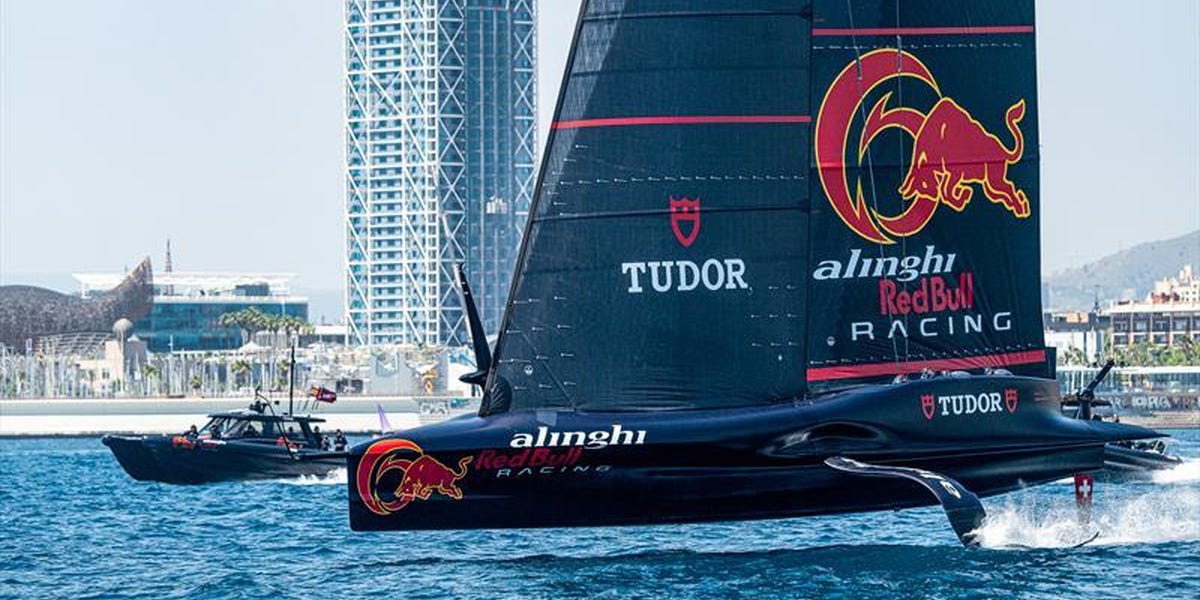 Alinghi Red Bull Racing’s America’s Cup yacht foiling off Barcelona. Photo: Ricardo Pinto / America’s Cup, via La Vanguardia.
ABOUT THOSE YACHTS
Mercedes-AMG Petronas, through Applied Science, helped develop INEOS Britannia’s America’s Cup yachts. Its contributions included simulation, control systems, and the foils that lift the boats above the water. Red Bull Racing’s sister engineering business, Red Bull Advanced Technologies, worked with Alinghi Red Bull Racing and collaborated with bicycle manufacturer BMC.
 Cyclist testing the bicycle in a wind tunnel. Photo: BMC Switzerland / Robbie Meade
These are real engineering businesses, and their existence does not establish wrongdoing. The concern, explained in Jon Noble’s reporting for The Race, is whether people paid for outside projects could also contribute to F1 without the corresponding costs entering the cap. We think that deserves scrutiny: useful advice from an aerodynamicist has value even when nobody bills for the conversation.

SEPARATE OFFICES, SEPARATE ACCESS
At affected facilities, restricted F1 and non-F1 employees must work in separate areas. Electronic access controls are mandatory, and records must remain available for three years. Wind tunnels, simulators, and dynos can serve both operations, generally at different times, with narrow exceptions for essential operational support.
Restricted IT access must also be segregated. The rules specifically prohibit using messaging systems, external drives, contracts, employee transfers, or intermediaries to evade the restrictions. Specified information can move from F1 to the outside business under controlled conditions, while transfers in the reverse direction are prohibited.

CHANGING JOBS GETS AWKWARD
An employee moving from the restricted non-F1 workforce into F1 faces at least three consecutive months doing neither F1 nor non-F1 work, without access to restricted systems or their outputs. At least 12 months of exclusive F1-related work follows. Three months unable to do either job is a substantial interruption, particularly for someone making an ordinary career move.
Moving out of F1 requires a new contractual arrangement, replacement IT permissions, and a new email account. The employee commits to at least 12 months of non-F1 work, while compensation for the reporting period generally remains inside the cap, subject to the financial rules’ exceptions. A yacht assignment remains possible, but moving someone onto another department’s payroll offers little immediate budget relief.

SOMEONE PAYS FOR THE PAPERWORK
Teams can still share functions including HR, finance, and specified IT support. They do not need two complete corporate administrations. Even so, separating engineering access and maintaining the required records will take staff time, and we would expect teams to feel that burden.
The Racereports that several teams resisted the strictness of the measures. We agree with the principle that engineering resources used for F1 belong within the cap’s controls. We are less convinced that every internal career move warrants three months of enforced inactivity. The FIA should explain why that delay is necessary and review whether it achieves enough to justify the disruption.
Next up: Christian Horner’s Drive: What the Red Bull Memoir Reveals