Your Daughter Wants to Be in F1? Part 1No Rule Bars Her, However Only 2 Women Ever Started a Grand Prix.
The routes open to a daughter, from a $3K rental kart to a $116K F1 Academy share. A Formula 4 season elsewhere costs $700K. Who pays at each step.
Listen to this article 18 min, narrated
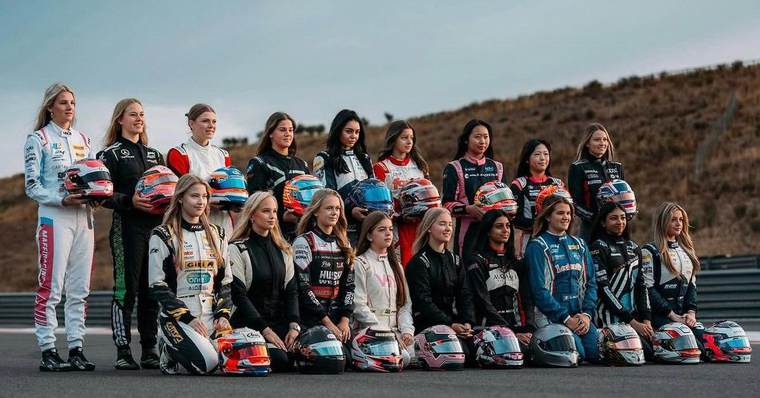
 F1 Academy’s 2026 graphic. Image: F1 Academy, via Instagram.
No rule keeps a daughter out of Formula 1. Girls make up 13% of karting participants and 4% of top-ranked racing talent. In Formula 1, only two women ever started a Grand Prix, the last of them 50 years ago, and in 2026 two women, Doriane Pin and Jamie Chadwick, tested older F1 cars. Indeed, the last woman to participate in an FP1 session in F1 was Susie Wolff, who took part in four FP1 sessions with Williams between 2014 and 2015. This is a guide for parents whose daughters want to race.
View on Instagram · @f1
On April 17, 2026, Pin, 22 y.o., drove a 2021 Mercedes F1 car for 76 laps at Silverstone in Britain. She was the first champion of F1 Academy, the women's single-seater series, to test an F1 car. On September 21, 2026, Chadwick, a British driver and three-time W Series champion, tested a 2025 Williams for 32 laps at Portimão in Portugal. Both ran in older-car testing programs, which F1 allows because it limits testing of current cars.
View on Instagram · @jamiechadwick
This is Part 1 of our two-part companion to the seven-part series for parents, "Your Kid Wants to Be in F1?" It answers one question: which routes can a daughter take into racing today, and what does each step cost?
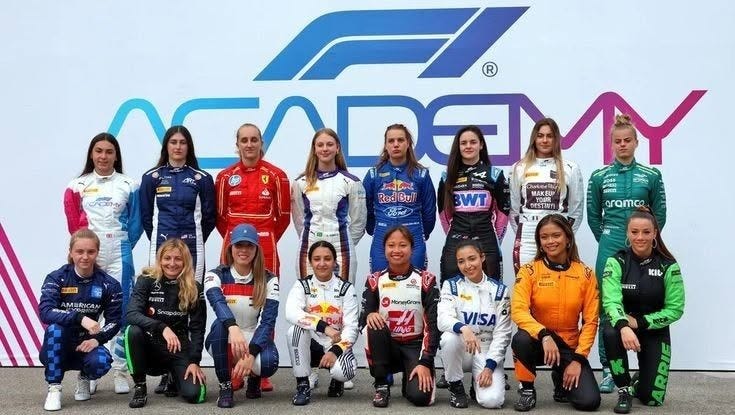
The short version for a parent: the routes start in karting, from age 6 in Britain, and car racing opens at 14 there. Costs climb from about $3K for a rental karting package to about $116K for a driver's share of an F1 Academy season in 2024, against about $700K in our earlier estimate for a Formula 4 season outside F1 Academy, for drivers of either gender, and to millions at Formula 3 and Formula 2. The sections below climb the ladder one step at a time.
THE HISTORY AND THE RULES
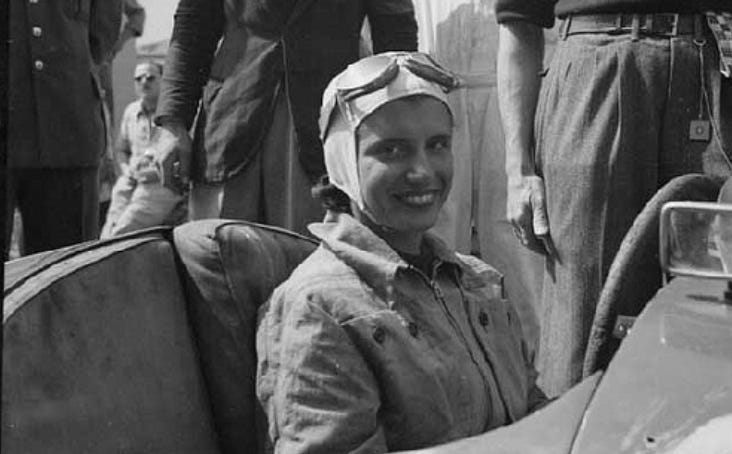 De Fillipis Grand Prix de San Fernando in 1949. Photo: Wikipedia.
Maria Teresa de Filippis started in Belgium in 1958, and Lella Lombardi's last start was in Austria in 1976. Entering a Grand Prix means a team registers a driver for the weekend, and only drivers who qualify with a fast enough lap make the starting grid. Lombardi recorded 17 entries and 12 starts from 1974 to 1976. At the 1975 Spanish Grand Prix, officials stopped the race after 29 of 75 scheduled laps, about 39% of the distance. The rules of the time paid half points for a race stopped between 30% and 60% of its distance, so her sixth place scored half a point, the only World Championship score by a woman. Today F1 no longer halves points: a stopped race pays a sliding scale tied to the distance run. The other three women who entered, Divina Galica, Desiré Wilson and Amati, failed to qualify for the race: Galica in 1976 and twice in 1978, Wilson in 1980 and Amati three times in 1992. The 2026 edition of Appendix L, the rulebook on driver licenses from the Fédération Internationale de l'Automobile (FIA), motorsport's governing body, uses masculine pronouns for drivers of either gender and one points table for every driver.
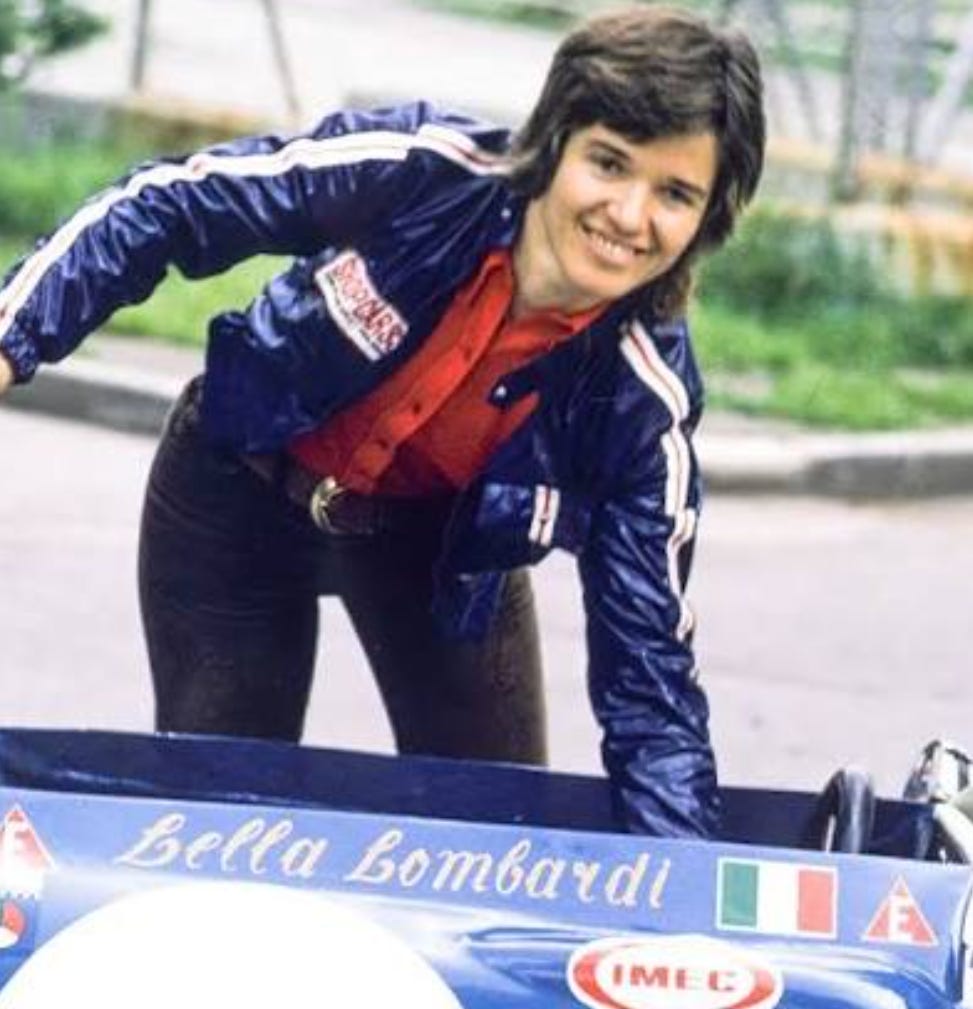 Lella Lombardi
Women also drove or tested F1 cars outside race weekends. From the sources we read, the list runs:
- 2002, Sarah Fisher: a demonstration run in a McLaren after first practice at the U.S. Grand Prix.
- 2005, Katherine Legge: a Minardi test at Vallelunga in Italy, 27 laps.
- 2011 and 2012, Maria de Villota: she drove a Renault R29 in 2011 and became a Marussia test driver in 2012, when she was badly injured in a straight-line test at Duxford in England.
- 2014, Simona de Silvestro: 112 laps in a Sauber C31 at Fiorano in Italy.
- 2018, Tatiana Calderon: a Sauber C37 test in Mexico City.
- 2023, Jessica Hawkins: 26 laps in an Aston Martin AMR21 at the Hungaroring in Hungary.
- 2026, Doriane Pin: 76 laps in a Mercedes W12 at Silverstone, as above.
- 2026, Jamie Chadwick: 32 laps in a Williams FW47 at Portimão, as above.
WHERE THE PIPELINE NARROWS
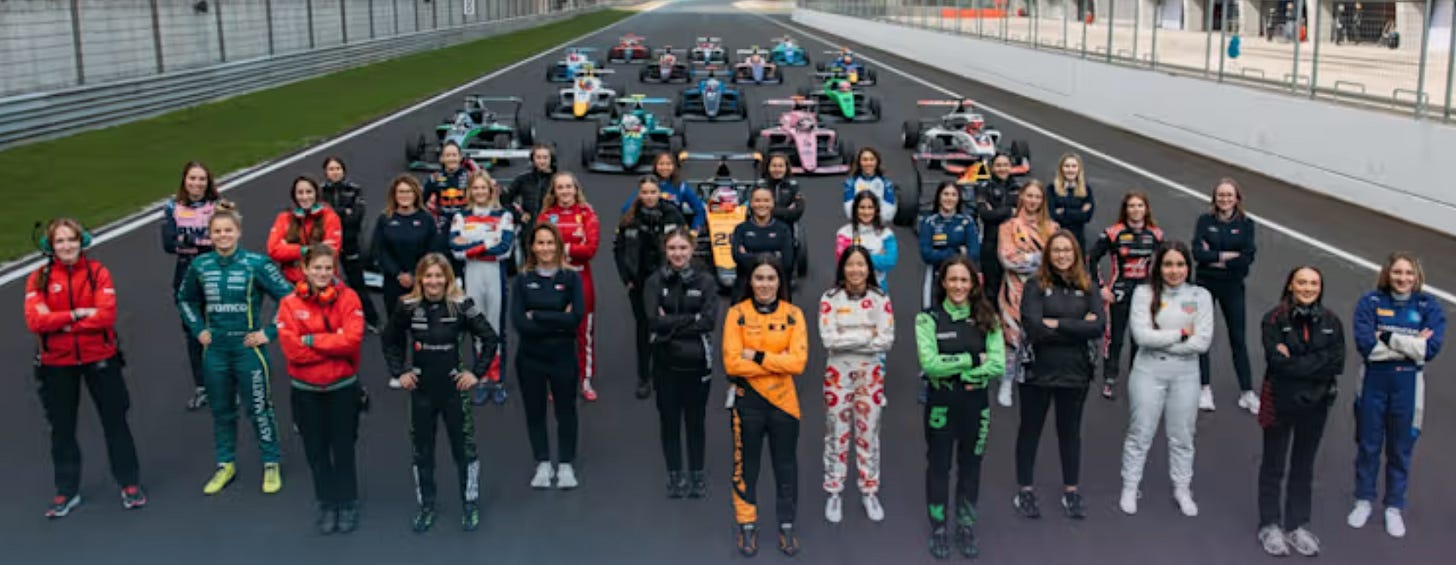
More Than Equal, a driver development organization founded by businessman Karel Komárek and former F1 driver David Coulthard, published its Inside Track report in 2023. Beyond the 13% and 4% above, it found that women and girls made up 7% of formula and GT participation and that karting supplied 40% of female participation. Female drivers' careers typically lasted 1 to 5 years, while men's careers were more likely to run beyond 12 years. Motorsport UK, Britain's national governing body, reported in March 2026 that only 5% of licensed racing drivers were women. More Than Equal also runs a selective Driver Development Programme that gives female racers individual technical, physical and mental coaching, especially through the move from karts to single-seaters. For a parent, those figures make the next affordable season a better planning unit than the whole ladder.
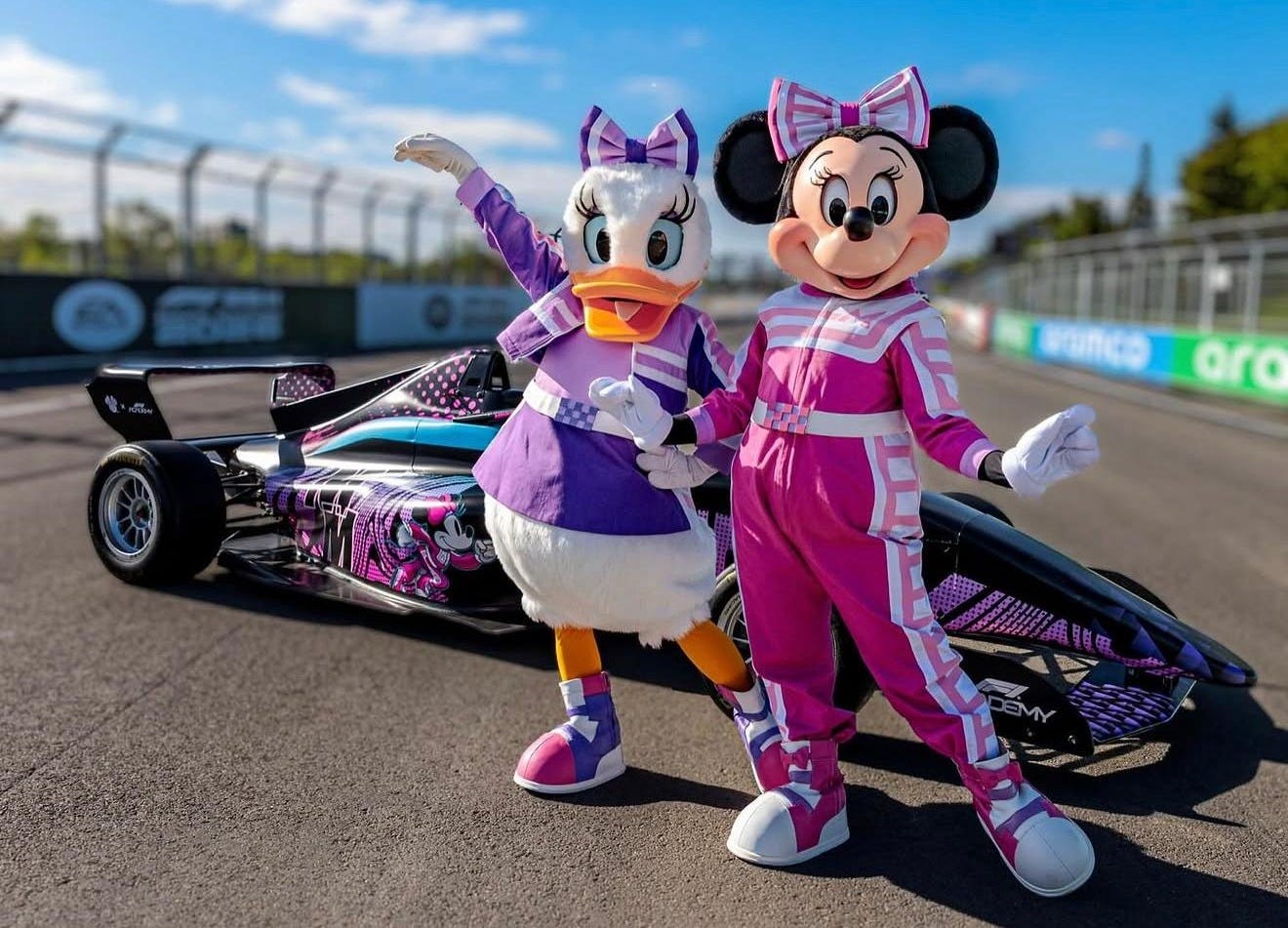 Montreal 2026 Photo: F1 Academy
THE FIRST STEPS FOR A DAUGHTER
In Britain, Bambino karting starts at age 6. F1 teams employ the scouts, not the FIA, and they look at children around ages 10 to 12, as we reported in the second article of our seven-part series. Motorsport UK's Girls Karting Academy, launched in 2025, offers beginner karting days for girls ages 8 to 15 at 14 British venues and explains how beginners can progress to the British Indoor Karting Championship. F1 Academy launched Discover Your Drive in 2023. Its first British karting pilot, run with Motorsport UK and the indoor kart operator TeamSport, targeted girls ages 8 to 12, and TeamSport instructors identified promising newcomers and offered development sessions. F1 Academy announced the 2026 intake in February 2026: 17 supported places, 9 in an international series and 8 in a British program, filled by 15 female karters because 2 of them hold a place in both. The age classes run from 8 to 17, and the karters get branded karts and race suits and a 30% discount on entry fees. In June 2026, its karters raced a round of the British Champions of the Future Academy program, which F1 Academy streamed live on YouTube.
View on Instagram · @f1academy
View on Instagram · @f1academy
Karting is not the only way in. Ella Lloyd, 21 y.o., a McLaren development driver, came to racing from showjumping and skiing, began at 16 and never raced karts. Dutch driver Maya Weug, then 16 y.o., won the inaugural FIA Girls on Track Rising Stars selection and became the first female member of the Ferrari Driver Academy, the Italian F1 team's junior program, in 2021.
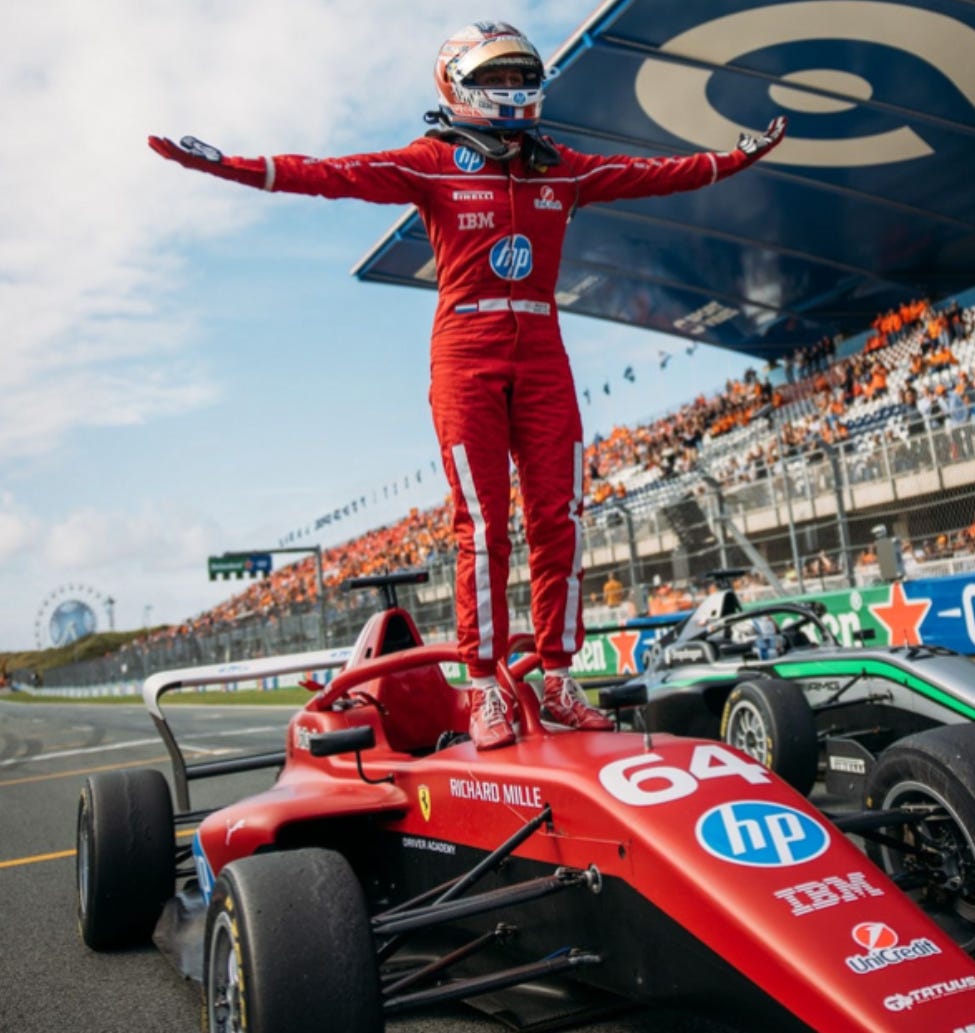 Maya Weug
For a U.S. starting price, one operator, Italian Motors USA in Sumas, Washington, listed a ten-race cadet or junior rental package at $2,999 in late 2026. The price included the kart, engine, helmet and suit. The driver remained responsible for damage, and a newcomer first needed to take the operator's karting course.
Another karting option sits in Germany, where the Nürburgring Langstrecken-Serie, the endurance racing series that runs at the Nürburgring circuit, launched the NLS Kart Slalom Championship in 2025 for children and young people ages 7 to 18, who drive 3.3 kW electric karts from Mach1 through timed courses on the circuit’s helipad during the series’ race weekends.
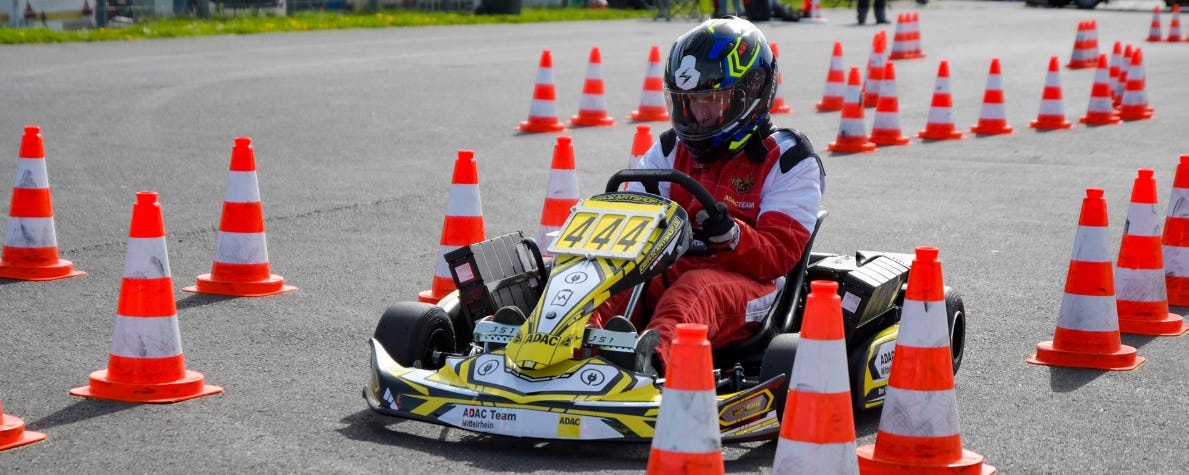 NLS Kart Slalom Championship
In Britain, car racing opens at 14 in the Ginetta Junior Championship, for drivers ages 14 to 17. Its annual Ginetta Junior Scholarship takes applicants who have never competed in a car, with no racing license required. The 2027 edition took place at Blyton Park in Lincolnshire on October 5 to 7, 2026. Judges scored driving (60% of the score), fitness and media skills, and the winner receives a fully funded 2027 season. Jamie Chadwick won the scholarship at 14 y.o. for the 2013 season, and Alisha Palmowski won it at 15 y.o. for the 2022 season. The GB4 Championship, a single-seater series, starts at age 15 and requires a Motorsport UK Race Club license. Its series fees come to about $26K for a full season before tax, and the cost of running a car comes on top. The series offers its leading female driver a contribution toward an F1 Academy seat, listed at about $55K for 2027.
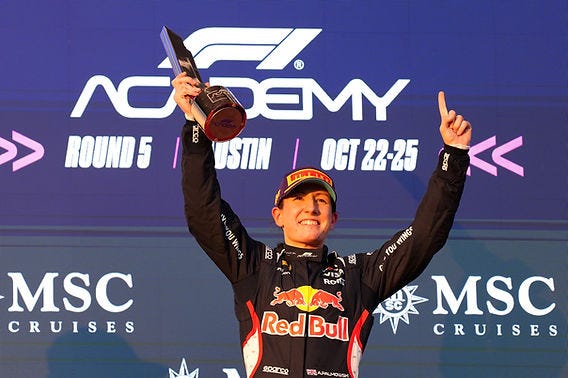 Alisha Palmowski
In the United States, the Formula Pro USA Western Championship, a West Coast series for Formula 4 and Formula Regional cars, runs a Women's Racing Series class for female drivers. Ana Palestro won the 2026 class title, 63 points to 53 over Yana Kapoor, and her best finish in the main Formula 4 class was 5th place.
Programs open to a daughter
Who runs each one, who it is for and what it offers
| Program | Run by | Who it is for | What it offers |
|---|---|---|---|
| Girls Karting Academy | Motorsport UK | Girls ages 8 to 15 | Beginner karting days at 14 British venues; a route to the British Indoor Karting Championship |
| Discover Your Drive | F1 Academy | Girls ages 8 to 17 (2026 intake) | 17 supported places for 15 karters in two series; branded karts and suits; 30% off entry fees |
| Girls on Track Rising Stars | FIA | Young female drivers | Winner of the first selection, Maya Weug, joined the Ferrari Driver Academy in 2021 |
| Driver Development Programme | More Than Equal | Selected female racers | Individual technical, physical and mental coaching, especially from karts to single-seaters |
| Formula Pro USA Western Women's Racing Series | Exclusive Racing | Female drivers in Formula 4 and Formula Regional cars | A women's class in a 12-race West Coast series: Sonoma, Thunderhill and Laguna Seca |
| Nürburgring Kart Slalom Championship | MSC-Adenau and the Nürburgring endurance series | Ages 7 to 18 | Timed courses in electric karts on the helipad during endurance race weekends |
| Ginetta Junior Scholarship | Ginetta | Drivers with no car racing experience | A funded season in the Ginetta Junior Championship; judged on driving, fitness and media skills |
| GB4 Championship | MotorSport Vision | Drivers ages 15 and older | British single-seater series; its leading female driver earns a contribution toward an F1 Academy seat |
| F1 Academy | Formula 1 | Women racing at Formula 4 level | Races on Grand Prix weekends; 10 of the 11 F1 teams back a driver; three champions won a funded seat |
F1 ACADEMY: A STEP ON THE LADDER
Formula 1 announced F1 Academy in 2022 for a 2023 debut in the Tatuus T421, a Formula 4-level car. The FIA describes a route from karting through Formula 4, Formula Regional, Formula 3 and Formula 2 to F1, and F1 Academy sits at the Formula 4 step. Susie Wolff, a former racing driver, took over as managing director in 2023, reporting to Formula 1 CEO Stefano Domenicali. The 2026 calendar runs 14 races across six weekends and ends in Las Vegas on November 19 to 21, 2026. Ten of the 11 teams on the 2026 Formula 1 grid back a driver and a livery in a multi-year partnership that the ten teams of the 2025 grid renewed in 2025, and the 11th team, the Cadillac Formula 1 Team, begins sponsoring an entry in 2027. F1 Academy held its 2026 Rookie Test at Circuito de Navarra in Spain on September 11, 2026, with 18 rookies driving.
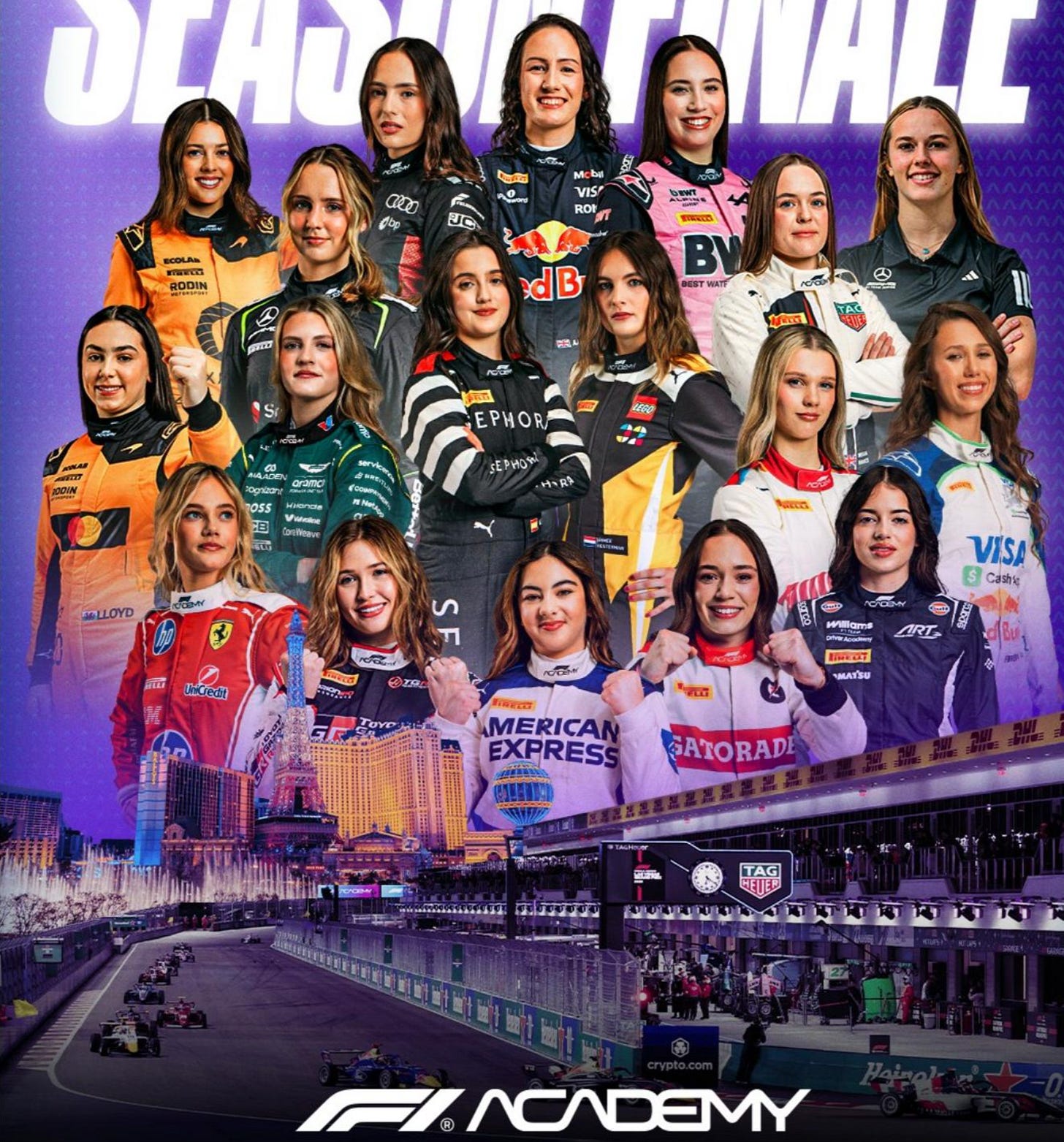 F1 Academy's 2026 season finale graphic. Image: F1 Academy, via Instagram.
View on Instagram · @f1academy
View on Instagram · @f1academy
At launch, Formula 1 subsidized each car with about $175K, the drivers covered the same amount and the teams covered the rest. The driver contribution fell to about $116K for 2024. Formula 1's launch release called the driver share a fraction of the usual costs in comparable series, and our earlier reporting estimated a full Formula 4 season at about $700K. Farther up the ladder, Coulthard put Formula 3 at about $2M and Formula 2 at more than $2.7M in April 2026, and the total to reach F1 readiness at roughly $11M starting in karts. Those are his estimates for drivers of either gender, in rounded dollars. Testing is a separate bill. In its 2025 price list, the French Winfield Racing School charged about $8,100 before tax for one Formula 4 test day, and about $9,400 with coaching and damage insurance added, with transport extra.
What each step on the ladder costs
Approximate figures in U.S. dollars, drivers of either gender
Heights not to scale.
The FIA awards F1 Academy's top five drivers 10, 7, 5, 3 and 1 Super License points. The standard route to an F1 Super License requires 40 points, and FIA karting can supply up to 12 of them, so by our arithmetic a title supplies a quarter of the threshold. Champions are not the only drivers who stay on the ladder. F1 Academy now lets select drivers who completed two seasons apply for a third, and two drivers, one backed by Ferrari and one by Audi, are confirmed for 2027. For a family weighing the series, the next seat and the testing attached to it deserve as much attention as the points.
WHAT TO DO NEXT
Start with one session. Book a visit at a local track or rental operator and ask for the full price list, including any course fee and the damage terms.
Then find a girls-only entry point. In Britain, options include the Girls Karting Academy and the Jamie Chadwick Series, a female-only karting championship at Daytona's UK venues where Chadwick mentors at selected rounds and Daytona membership is required. Discover Your Drive runs British and international programs. Elsewhere, ask your national motorsport federation whether a similar program exists.
Around ages 10 to 12, when scouts begin to look, plan a season of results in a recognized series.
At 14 or 15, car racing opens. The Ginetta Junior Scholarship takes drivers with no car racing experience, and the GB4 Championship starts at 15.
LESSONS LEARNED
Compare entry points by what each includes. Our U.S. example covered the kart, engine, helmet and suit, and the Discover Your Drive intake added a 30% discount on entry fees.
Find out who is doing the selecting. Ask the person watching your daughter which specific skill would earn another look, and whether a program, a team or a scout makes the choice.
Track progress on the Super License table. When you compare series, write down what she would learn, how often she would race and how many points a result could earn.
The routes into racing for a daughter start with a local karting budget, add girls-only programs and car-racing entry points along the way and reach single-seaters at F1 Academy. We would plan one season at a time and check the price of the next step before taking it. Which step is your daughter on today, and what does it cost your family?
Next in this series: Your Daughter Wants to Be in F1? Part 2: Two Paths After F1 Academy, a Funded Seat and a Public Appeal for a Call