F1 Engineers: Stay in F1 for $100K to $200K, or Leave F1 for Trading Firms and Average Up to $800K
Average pay per employee from company accounts, profit sharing included. Hedge funds, a $2.4B AI startup, Tesla, Ford and drone makers hire F1's engineers, most of them after 5 to 8 years.
Listen to this article 19 min, narrated
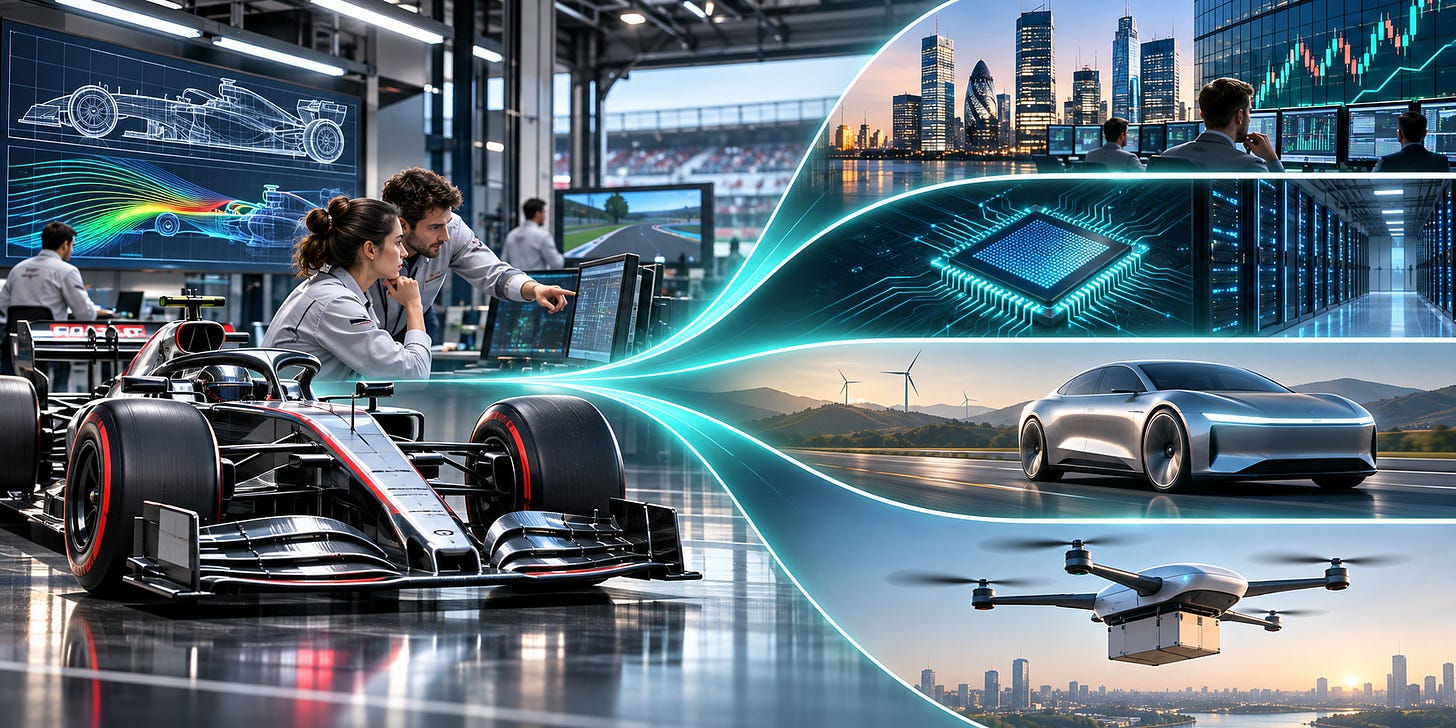 AI-generated illustration.
F1 teams spend years training engineers, and other industries hire them. A Haas aerodynamicist went to the natural-gas trading desk of Balyasny, a Chicago hedge fund. Red Bull's head of high-performance computing went to Millennium, a New York hedge fund. A McLaren engineer now leads technology for a trend-trading arm at Man Group, a London hedge fund manager, and a Williams computational fluid dynamics engineer went to Squarepoint, a hedge fund based in New York and London. Ferrari's new-concepts aerodynamicist became chief aerodynamics engineer at Xiaomi, a Chinese phone and electric-car maker. A Mercedes hydraulics engineer writes autopilot software for Windracers, a British maker of self-flying cargo drones. Toto Wolff, the Mercedes team principal, said on October 9, 2026 that after 5, 6 or 7 years F1 pay falls behind tech companies, hedge funds and banks. Four of the finance moves came in exactly that window. The rest of the map runs through AI startups, one valued at $2.4B, road-car makers, drone makers, and a few engineers who came back.
THE PLACEMENT YEAR
The pipeline starts before graduation. Many UK engineering students spend a placement year, a paid year in industry, inside a company during their degree, and F1 teams take them in. Six F1-linked people we traced into finance spent 4 to 14 months at McLaren, Red Bull or Mercedes as students or interns, then went to trading firms.
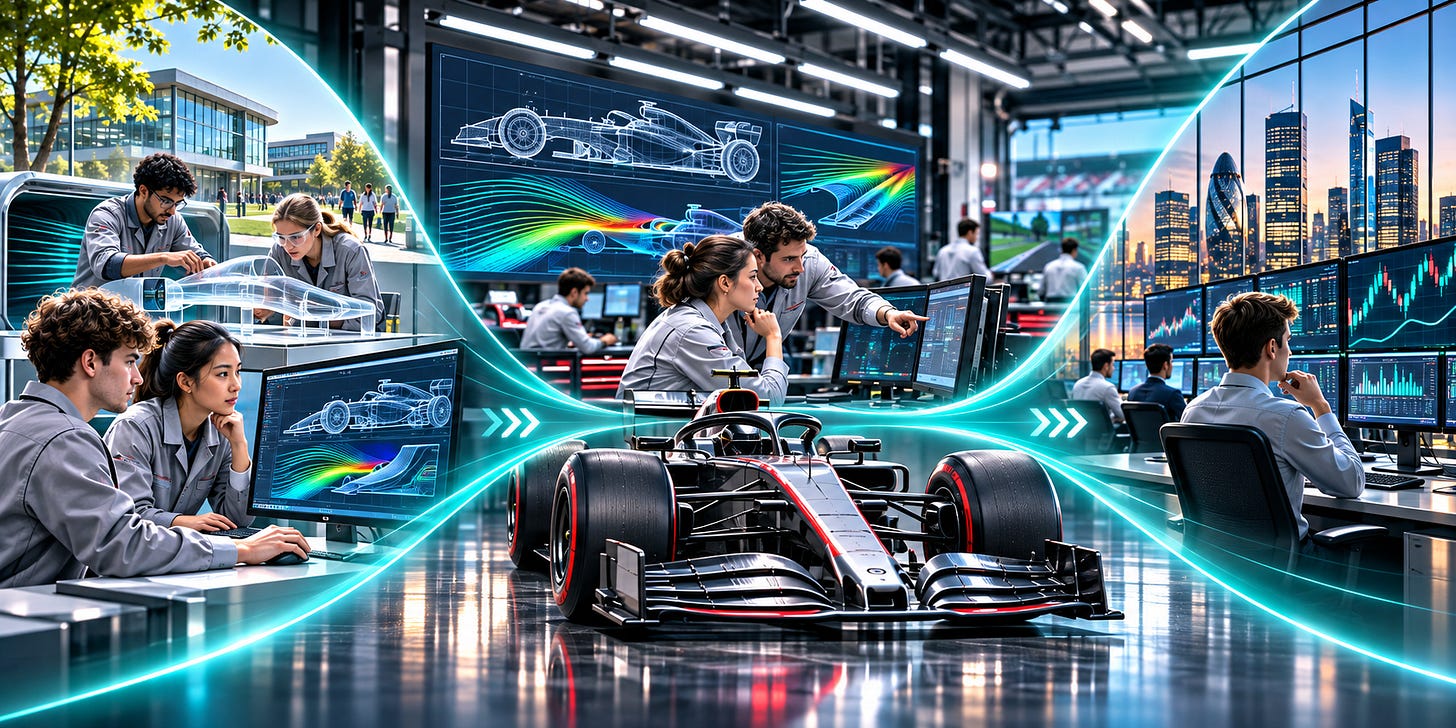 University engineering students moving into F1 and eventually finance. AI-generated illustration.
Most of them joined market makers, firms that trade their own money and constantly quote buy and sell prices so others can trade: Optiver, based in Amsterdam; Old Mission, a Chicago firm that specializes in exchange-traded funds (ETFs) and has a London office; Virtu Financial, based in New York with a London office; and Chicago Trading Company, an options trading firm with offices in London and Amsterdam. The four who joined market makers did so within about two years of their placements, most of them after finishing their degrees. Two reached hedge funds, the private investment funds that pursue returns with a mix of strategies, by longer routes, one through a doctorate and the other through years at other funds: Balyasny Asset Management, a multi-strategy hedge fund based in Chicago with a London office, and Millennium Management, a multi-strategy hedge fund based in New York with its main European office in London and others in Paris, Dublin and Geneva.
YEAR 6
At the FIA press conference in Singapore, Wolff said a team can hire graduates on enthusiasm, but after 5, 6 or 7 years with a PhD the pay still trails "a tech company or a hedge fund or investment banking." He asked for more room inside the cost cap for lower salaries and said smaller teams would object. The gap is wide. Fluid Jobs, a motorsport recruitment firm, put senior motorsport engineers at $84K to $129K in its December 2024 survey, while a London trading-firm software engineer earns about $235K on base. Adrian Newey said in April 2024 that F1 was losing people to tech companies.
The companies' own accounts put numbers on the gap. In 2025, average wages came to about $136K per employee at Mercedes, $102K at Williams and $211K across Red Bull Technology, directors included. Squarepoint's London staff company paid about $397K per employee, and Optiver's London arm about $793K once profit sharing is counted. Not every exit pays more: TEKEVER's UK company averaged about $66K.
Millennium advertises New York software engineers at a base of $175K to $250K and Citadel at $150K to $300K, before bonuses. PhysicsX advertises New York simulation engineers at $138K to $217K, and Rivian offers a staff aerodynamicist with motorsport experience $154K to $192K in Southern California. Tesla's own ad for a senior aerodynamics engineer in Hawthorne, California lists $87K to $262K, plus cash and stock awards. In London, PhysicsX advertised a senior simulation engineer at about $134K to $168K, above the top of Fluid Jobs' senior motorsport band.
 An engineer facing a career choice between Formula 1 and a hedge fund. AI-generated illustration.
Public LinkedIn profiles show who left in that window. Red Bull’s head of high-performance computing, eight years at the team, joined Millennium in April 2026. A Mercedes principal software engineer of almost seven years joined G-Research, a London firm that uses data and computing to find trades, in 2021. A McLaren vehicle dynamics engineer of 6.5 years, who supported the cars of Fernando Alonso, Carlos Sainz and Lando Norris from the factory, joined Wellington Management, a Boston asset manager with a London office, in 2022, in what his profile describes as its hedge fund business. A Haas aerodynamicist of more than five years at the US team’s North Carolina headquarters (Haas also runs a base in Banbury, England, and a design office in Maranello, Italy) spent two years at Bank of America, whose European hub is in Dublin with a branch in London, before joining Balyasny’s natural-gas trading desk in January 2023.
Others did not wait for year 6. A Mercedes race engineering software engineer of 2.5 years joined the London office of Citadel, a multi-strategy hedge fund headquartered in Miami whose second-largest investment office is in London, in August 2021. A McLaren high-performance computing engineer joined Man Group, a London-listed hedge fund manager, in 2022 and now leads technology for the trend strategies of AHL, its computer-driven trading arm. A Williams computational fluid dynamics engineer of three years went to Squarepoint Capital, a hedge fund that trades with computer models from New York and London, in 2023. Two routes are on the public record. Alexander Barcus, a vehicle dynamics engineer at Mercedes and McLaren who worked on driver-in-the-loop simulation, spent 4 years at GHCO, a London market maker in exchange-traded funds owned by South Korea's Mirae Asset, and now works on JPMorgan's London-based Global Aggregate bond team. Andrew Bailey, McLaren's head of vehicle design from 2008, moved to McLaren GT in 2012, joined the asset manager Schroders in 2015 as chief operating officer and global head of process engineering, and became an operations director at G-Research in 2017.
THE AI STARTUPS
That Williams engineer left Squarepoint in October 2026 for PhysicsX, a London company that builds AI models to replace slow engineering simulations. Its founder and chairman, Robin Tuluie, joined Mercedes in 2011 as chief scientist and head of R&D, moved to Bentley, the Volkswagen Group luxury car maker in Crewe, England, in 2016 as vehicle technology director, then set up an engineering consultancy before founding PhysicsX in 2019. Its chief executive, Jacomo Corbo, joined as co-CEO in February 2023 from QuantumBlack, McKinsey's AI unit, after serving as Renault F1's chief race strategist from 2006 to 2008. In June 2026 PhysicsX raised $300M led by Temasek, the Singapore state investment company, at a valuation of about $2.4B, and its headcount grew from 150 to 350 in a year. Corbo called the company "very supply-side limited," with demand running ahead of its capacity and its fastest growth in data center hardware and semiconductors, industries with no cost cap. In August 2026 PhysicsX also hired a Red Bull aerodynamics engineer who worked on front wing concepts for the RB21 and RB22, for its New York office.
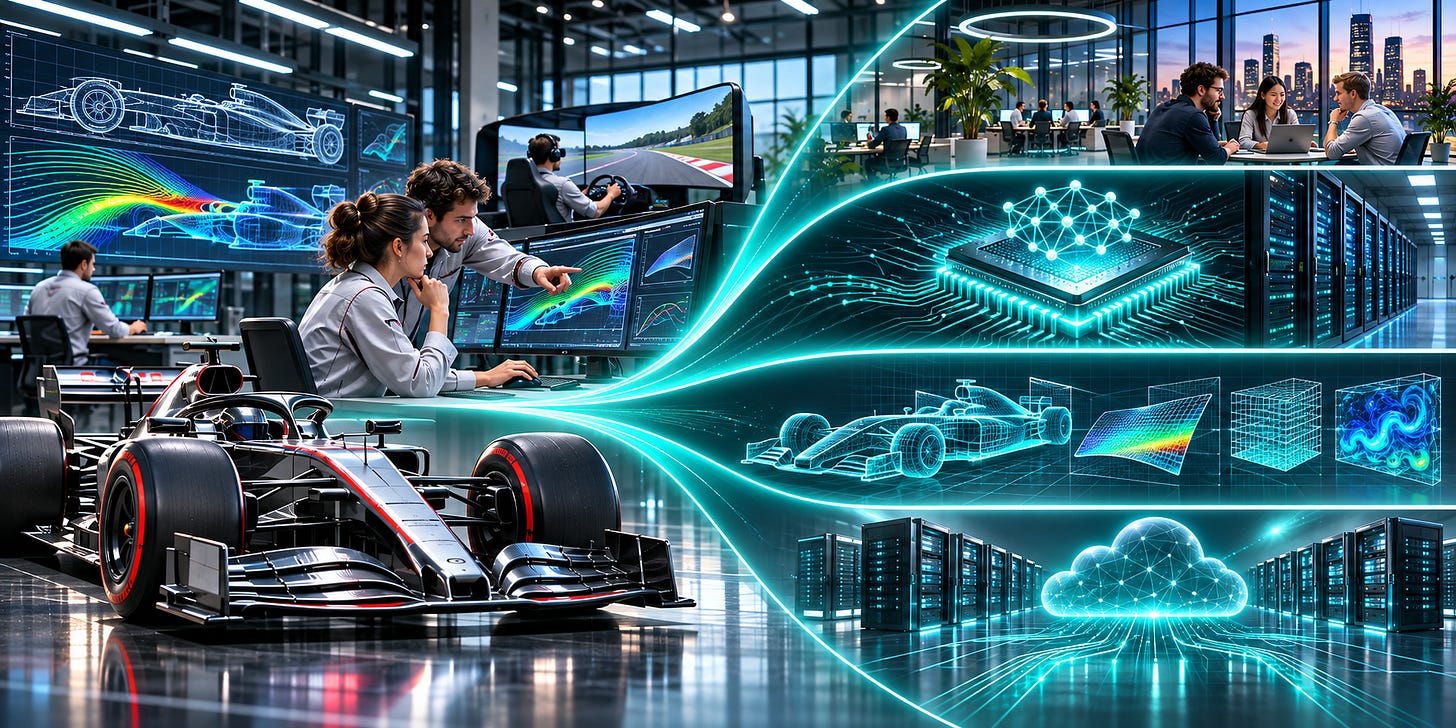 F1 simulation expertise moving into artificial intelligence, computational engineering, and data centers. AI-generated illustration.
microagi, a Munich startup that trains factory robots on data from real workers, was founded in September 2025; its founders include former Red Bull aerodynamics engineer Bercan Kilic and Yoan Iliev, formerly of Mercedes. It raised a $55M seed round in July 2026, led by the venture firm Hummingbird Ventures.
The longest route ends at a model developer. Neil Ashton worked at Lotus F1, now Alpine, in 2012 and 2013, helping develop the team's CFD methods and its high-performance computing. He then moved into university research at Manchester and Oxford, consulted for Formula 1 Management, and held senior roles, from his base near Oxford, at Amazon's cloud unit and the chip maker NVIDIA. In September 2026 he joined Mistral, a Paris-based developer of AI language models, as vice president of computational engineering. One name links F1 to the big AI labs. During his PhD, Raza Habib spent a day a week inside McLaren's offices for Monolith AI, a machine learning startup McLaren hired to help choose which wind tunnel tests to run next. He co-founded Humanloop, an AI software company, and in August 2025 he and his co-founders joined Anthropic. We found no former F1 team employee at OpenAI, Anthropic or Google DeepMind, all three of which have London offices.
THE CAR MAKERS AND THE DRONE MAKERS
Road-car makers take the aerodynamicists. A Red Bull aerodynamicist of almost 11 years, who led the team’s front-end aerodynamic development from 2014 to 2018, joined Tesla in California in 2018 and now runs its aerodynamics and aeroacoustics engineering; Tesla also builds cars near Berlin and runs an engineering center there. A CFD tools engineer with six years at Williams and Red Bull joined Tesla in 2023. A former Red Bull aerodynamicist joined Ford‘s advanced electric-vehicle group in California in 2023, by way of Dstl, the UK defense ministry’s laboratory, and Formula 1’s own car-concept team, which moved to the FIA in January 2022; Ford’s European development center is in Cologne, Germany. A Williams data engineer, Efimia Panagiotaki, became lead self-driving software engineer at StreetDrone and now works as an applied research scientist at Oxa, the Oxford self-driving company that bought it.
Ricard Aiguabella's path crossed both worlds. After five and a half years at Force India, he spent about two years at Tesla in the US, at a center where, he said, former F1 engineers developed new Tesla models, and led aerodynamics on the Model Y. Ferrari then offered him a job on new aerodynamic concepts without a technical interview. He later became chief aerodynamics engineer at Xiaomi. Since August 2026 he consults for TEKEVER, a Portuguese defense drone maker with six sites in the UK.
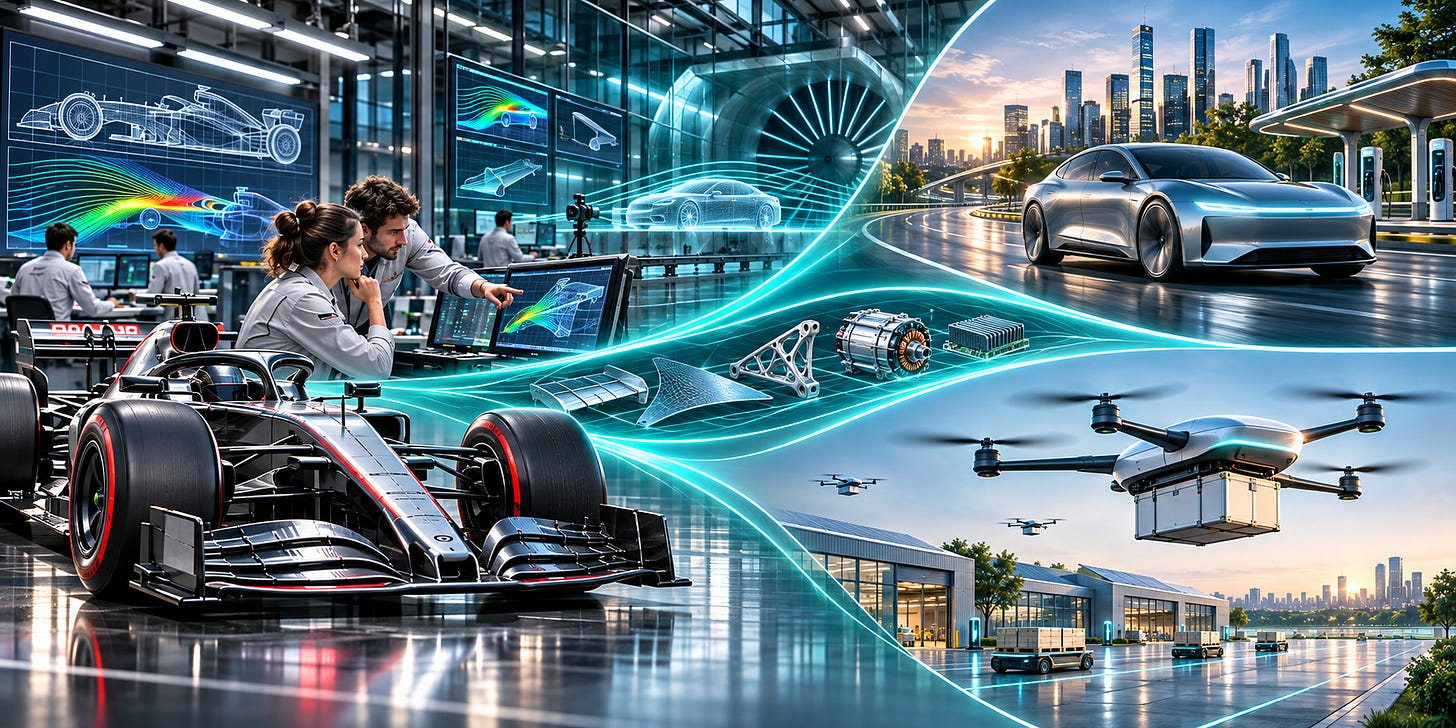 Aerodynamics expertise transferring into electric vehicles and autonomous aircraft. AI-generated illustration.
Gabe Elias, a Miami native, spent seven seasons as a Mercedes design engineer, then joined Rivian, the California electric-truck maker whose European technology center is in Belgrade, Serbia, in late 2020. Rivian paid well, he said, and early-career F1 pay did not compare, but Rivian lacked the support that let him design a part on a Tuesday and see it at a track on Friday. In 2023 he co-founded Material, a Miami startup that 3D-prints batteries, which announced a $7.1M seed round in January 2026 and a $1.25M Air Force contract to build batteries into small military drones.
Drones and aerospace take others. A former Mercedes hydraulic design engineer writes autopilot software at Windracers in Southampton. An aerodynamicist with 15 years at Williams, Force India, Caterham and Ferrari took an executive MBA at Oxford and now manages projects at NLR (DNW), a Dutch-German wind tunnel group. Finance technology hires them too: Axyon AI, a Modena company that sells AI forecasting to asset managers and hedge funds, hired a Ferrari F1 electronic engineer of almost eight years, and NCR Atleos, the US cash machine maker, hired an Aston Martin graduate electronics engineer at its research center in Dundee, Scotland.
THE WAIT
An offer is not a start date. Elias gave Mercedes six months' notice. Michael Broadhurst left Red Bull about five months before starting at Alpine in July 2024 after gardening leave, a wait of about seven months.
The rules now lengthen some waits. The World Motor Sport Council approved Section F of the 2027 operational regulations on October 19, 2026. Teams must keep restricted factory areas for F1 staff, retain access records for three years, and apply a three-month separation before an engineer moves from outside work into F1, with a 12-month minimum assignment after a transfer. Christian Horner, the former Red Bull principal, estimated that leading teams spend $500M to $600M a year across their groups, against a $215M cap; the new rules do not show that any team broke it.
THE WAY BACK
Some come home. Dan Fallows, Red Bull's former head of aerodynamics, ran Aston Martin's technical department and then his own consultancy, Hiperformant, founded in June 2025, before Racing Bulls named him technical director on January 23, 2026. Thomas Fuhr led Mercedes' engine business from 2009 to 2012, then spent about 14 years at the German bathroom-fittings maker GROHE, the Japanese building-products group LIXIL and two more industrial companies. He returned in November 2026 as chief executive of Audi Formula Racing GmbH, the Neuburg, Germany company that builds Audi's F1 powertrain.
LESSONS LEARNED
- For teams, the exit window is years five to eight. Four of the seven full-time finance moves we traced on LinkedIn came in that span, the window Wolff described in Singapore, so pay reviews and promotions that land before year five reach engineers before the recruiters do.
- For students and parents, a placement year at an F1 team opens doors well beyond racing. Six of the finance profiles we traced began with 4 to 14 months at McLaren, Red Bull or Mercedes.
- For engineers weighing an exit, the skills that travel furthest are simulation, software and computing. Race software, computational fluid dynamics, vehicle modeling and high-performance computing engineers made every hedge fund move we found, while aerodynamicists went to car makers and drone makers.
- Budget the wait. Notice and gardening leave ran six to seven months in the cases we found, and from 2027 Section F adds a three-month separation for engineers moving into F1 work.
- Leaving can be temporary. Fallows returned as a technical director and Fuhr as a chief executive, each with experience F1 could not have given them.
Next up: Cadillac F1 Is for Sale at $3B. What Should Its Sponsors Do Now?